Sri Lanka Top Tours | Island Bloom
.
Lorem ipsum dolor sit amet, consectetur adipiscing elit. Ut elit tellus, luctus nec ullamcorper mattis, pulvinar dapibus leo.
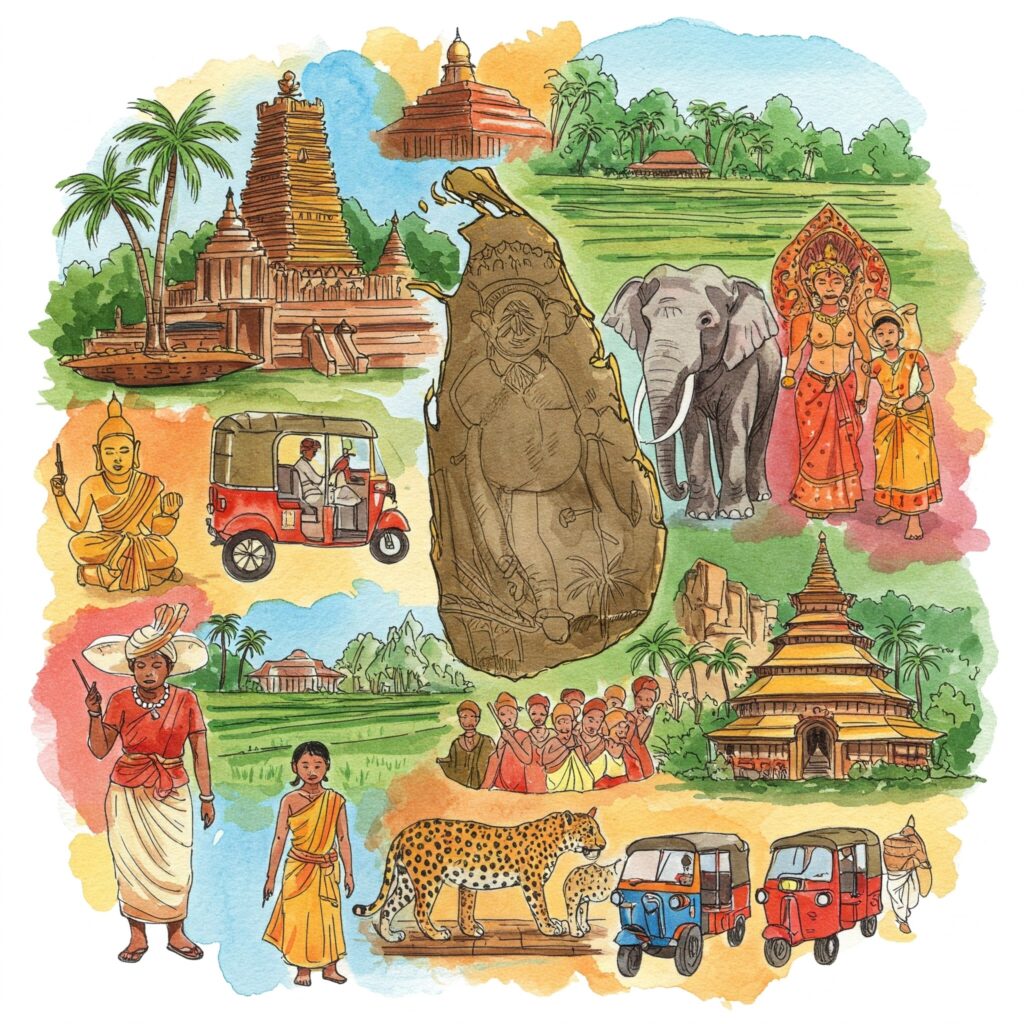
Imagine an emerald teardrop suspended in the vast blue of the Indian Ocean—this is Sri Lanka, an island where history whispers through ancient stone, where tales of kings and queens dance among towering dagobas, and where the past lives on in vibrant traditions that have survived millennia. Join me on a journey through time as we explore the enchanting history of this magical island, from mythical beginnings to its vibrant present.
Long before recorded history, legend tells us that Prince Vijaya—a banished prince from northern India—arrived on these shores in 543 BCE, precisely the day Buddha attained enlightenment. What serendipity! The term “serendipity” itself is derived from “Serendib,” one of Sri Lanka’s ancient names, and this happy accident of discovery seems fitting for an island where unexpected wonders await around every corner.
Vijaya and his followers allegedly encountered the island’s indigenous inhabitants, the Yakkas and Nagas, mysterious peoples now woven into folklore. While historians debate the literal truth of these tales, the story of Vijaya’s arrival has become the beloved founding myth of Sinhalese civilization, celebrated in the epic poem Mahavamsa (“Great Chronicle”).
Oh, to have witnessed the rise of Anuradhapura (377 BCE-1017 CE)—Sri Lanka’s first kingdom and one of the ancient world’s greatest cities! Can you imagine walking its streets in the 1st century CE when it rivaled Rome in size and sophistication? The city’s magnificent dagobas (stupas) still pierce the sky today, their massive white domes visible for miles across the plains.
I’m enchanted by the Jetavanaramaya stupa—once the third tallest structure in the ancient world, after the Egyptian pyramids. Its construction required millions of bricks, each crafted by hand. When standing beneath it, I always wonder about the countless individuals who carried stones and shaped clay, their combined dedication creating something so magnificent it still inspires awe 1,500 years later.
Anuradhapura’s kings gifted the island with engineering marvels that continue to baffle modern minds. The Abhayagiri reservoir and the intricate irrigation systems transformed the dry northern plains into a fertile paradise. Some call Sri Lanka the world’s first hydraulic civilization—what a delightful blend of pragmatism and ambition!
Perhaps most wondrous of all is the Sri Maha Bodhi tree, brought as a sapling from India in the 3rd century BCE by Princess Sanghamitta. This living connection to Buddha himself has been continuously tended for over 2,200 years, making it the oldest historically documented tree in the world. Standing beneath its sacred branches connects you to countless pilgrims across centuries who sought wisdom in its gentle shade.
When foreign invasions threatened Anuradhapura, the kingdom’s heart moved eastward to Polonnaruwa (1017-1255 CE). Here, King Parakramabahu the Great (1153-1186 CE) proclaimed, “Not even a drop of water should flow into the ocean without serving mankind”—words that inspired the creation of the vast Parakrama Samudra (“Sea of Parakrama”), an artificial lake so immense sailors reported losing sight of shore!
Polonnaruwa’s rulers embraced both Buddhist spirituality and worldly pleasures. The Gal Vihara Buddha statues, carved from a single granite wall, display such serenity that even today visitors fall silent in their presence. Meanwhile, the royal pleasure gardens with their ingenious hydraulic showers suggest that these ancient kings knew how to delight in life’s joys.
As European powers began arriving on Sri Lanka’s shores in the 16th century, the kingdom of Kandy retreated into the mist-shrouded central highlands, creating a mountain fortress that remained the last independent Sinhalese kingdom until 1815. Kandy’s greatest treasure—the sacred tooth relic of Buddha—became the symbol of sovereignty, whoever possessed it held the right to rule the island.
The Esala Perahera, a magnificent procession celebrating this relic, continues today as one of the world’s most spectacular festivals. Dozens of caparisoned elephants, thousands of dancers and drummers, fire-jugglers, and whip-crackers parade through candlelit streets for ten magical nights. Standing among the crowds as this living history passes by connects you to countless generations who have witnessed this same spectacle.
Sri Lanka’s strategic location made it irresistible to seafaring powers. The Portuguese arrived in 1505, bringing Christianity and European architecture. The Dutch followed in 1658, leaving behind their distinctive gabled buildings and a complex legal system still partially in effect today. The British took control in 1796, transforming the island they called Ceylon into a crown jewel of their empire.
I find particular charm in Galle Fort, where Portuguese, Dutch, British, Arab, Malay, and Indian influences blend in a living architectural museum. Walking its ramparts at sunset, with the Indian Ocean stretching beyond ancient stone walls, time seems to fold upon itself—16th-century conquistadors, 18th-century merchants, and 21st-century travelers all sharing the same breathtaking view.
The British brought tea, transforming the island’s misty highlands into a patchwork of emerald plantations. Scottish planter James Taylor planted the first commercial tea estate in 1867 at Loolecondera. When I visit these hills, watching tea pluckers with their baskets move deftly through the green slopes, I marvel at how this introduced crop became so intertwined with Sri Lankan identity that it’s impossible to imagine the landscape without it.
After peaceful campaigning for independence, Ceylon became a free nation on February 4, 1948. In 1972, the country reclaimed its ancient name—Sri Lanka, “Resplendent Land”—a fitting title for an island of such extraordinary beauty and cultural wealth.
The decades since have brought both challenges and triumphs. The 26-year civil conflict that ended in 2009 caused immense suffering, yet Sri Lanka’s resilience shines through in its remarkable recovery. Ancient sites damaged in fighting have been lovingly restored, and communities once divided now cautiously rebuild connections.
Tourism has blossomed, allowing visitors from around the world to discover what Arab traders long ago called “Serendib” and what Marco Polo declared “the finest island of its size in the world.” From whale-watching in the azure waters of Mirissa to scaling the vertiginous heights of Sigiriya Rock Fortress, from sampling spicy street food in Colombo to meditating in ancient forest monasteries, this island offers experiences that touch the soul.
What makes Sri Lanka’s history truly magical is how vibrantly it lives in the present. The techniques used to create the intricate irrigation systems of ancient Anuradhapura inform modern agricultural practices. The Ayurvedic medical knowledge cultivated by ancient healers continues to treat patients today. Traditional crafts—masks carved from lightweight kaduru wood, vibrant batik textiles, intricate brasswork—are still created using methods passed down through generations.
In village homes, families light oil lamps and place fresh jasmine flowers before images of Buddha, continuing devotional practices unchanged for millennia. During Sinhala and Tamil New Year celebrations each April, the entire nation participates in traditions established in antiquity, cooking milk rice at auspicious times and playing traditional games in village squares.
Isn’t it remarkable that in this fast-changing world, a place exists where the ancient and modern coexist so harmoniously? Where you might see a saffron-robed monk checking his smartphone beneath a 2,000-year-old stupa? Where traditional outrigger fishing boats called oruvas, their design unchanged for centuries, might contain fishermen using GPS technology?
Sri Lanka’s history isn’t confined to museum displays or textbook pages—it’s a living, breathing presence that infuses everyday life with meaning and depth. As a visitor, you don’t merely observe this historical pageant; you become part of its ongoing story, another traveler enchanted by this remarkable island.
Perhaps that’s the most magical aspect of Sri Lanka’s history: it continues to unfold, with each generation adding new chapters while honoring what came before. From the mythical arrival of Prince Vijaya to the latest developments in this vibrant democracy, Sri Lanka’s story is one of resilience, cultural richness, and enduring beauty.
When you visit, walk softly among ancient stones, listen for echoes of bygone eras in temple bells, taste centuries of culinary evolution in a perfect curry, and feel the unbroken thread of tradition in festival drumbeats. In this resplendent land, history isn’t just something that happened long ago—it’s alive all around you, waiting to be discovered with an open heart and wondering eyes.
Come, add your footsteps to the millions who have marveled at this jewel of an island. Sri Lanka’s enchanting history awaits, ready to weave its spell over you as it has done for countless travelers across the ages.